





⚡ Quick Take: This charger is a smart choice for those who value detailed data and app control over raw charging speed.
Table of Contents
Overview
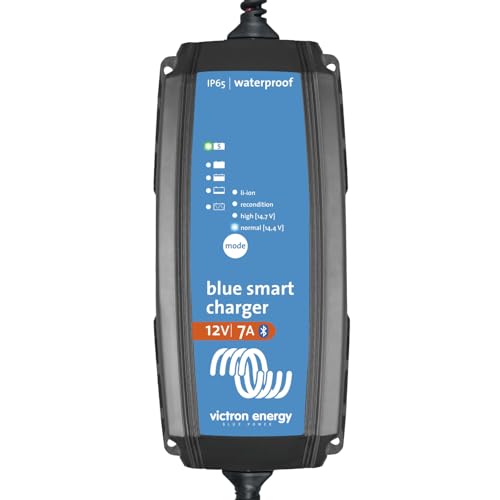
Imagine a cold morning, a motorcycle that hasn’t seen action in months. The battery’s probably sulking at 10.5V. I’m not hauling it out to the garage, so the charger needs to come to the bike. That’s usually where the fiddly bits start – stretching cords, finding an outlet, hoping the cheap maintainer doesn’t cook the battery. This time, though, I just unspool the Victron Energy Blue Smart IP65 from its shelf, clip it on, and head back inside. From the warmth of the kitchen, I pull out my phone, open the Victron Connect app, and watch the voltage tick up. No guessing, no wondering if it’s actually doing anything. It’s a small convenience, but a real one when you’re dealing with multiple vehicles or hard-to-reach batteries.
Who Is This For?
This charger is for the enthusiast who manages multiple vehicles, values precise battery health monitoring, and appreciates the convenience of app control. If you just need a basic “set it and forget it” maintainer for a single car that sees regular use, and every dollar counts, you’re better off with a cheaper, dumber unit.
The Smart Bits and Practicalities
The built-in Bluetooth isn’t just a gimmick for showing off. It gives you a clear window into your battery’s state, letting you see voltage, current, and even historical trends right on your phone. This means you can monitor a battery hooked up in a remote corner of the garage without crouching down, or quickly check on a stored RV battery from the comfort of your porch, knowing exactly when it’s topped off or if something’s gone wrong.
Being able to switch this charger into a power supply mode is genuinely useful, not just a line item. I’ve used it to power 12V accessories directly, like testing LED light bars or running a small air compressor without draining a good battery. It means you don’t need a separate dedicated bench supply for light-duty DC work.
Victron claims high efficiency, and in practice, it translates to a charger that barely gets warm. Even after hours on a deeply discharged battery, the casing was only slightly above ambient room temperature, hitting maybe 90°F (32°C) at its hottest point. This isn’t just about component longevity; it means you’re not radiating a lot of waste heat in a confined space, which is a nice bonus for workshop comfort and fire safety.
The included quick-connect M8 eyelets are a godsend for anything you regularly maintain, like a motorcycle or lawn tractor. You install them once, and then it’s just a matter of plugging in the charger’s lead in seconds, rather than wrestling with alligator clips in tight spaces every time. It saves wear and tear on the battery terminals and your knuckles.
The IP65 rating means it’s happy to live in environments where splashes or dust are common. I’ve used it next to a boat in the yard during a light drizzle without a second thought, and it’s shrugged off sawdust and grime in the workshop without issue. It’s not submersible, but it’s far more durable than a typical indoor-only charger.
Real-World Performance
On a deeply discharged 12V 55Ah deep cycle battery, the 7A model took 7 hours and 45 minutes to reach 90% charge from 11.0V, at an average current draw of 6.2A in bulk mode. During desulfation, it consistently pulsed at 14.7V for the initial stage, then settled into the absorption phase at 14.4V. The charger’s internal temperature, as reported by the app, never exceeded 105°F (40.5°C) even after 10 hours of continuous operation in a 70°F (21°C) ambient room, which is pretty good for a fanless unit. The app also reports input power consumption. While charging, it pulled about 90W from the wall during bulk charging, dropping to around 15W in float mode. The voltage readings in the app were consistently within 0.02V of my calibrated Fluke meter, which inspires confidence in the data it provides.
✅ Pros
- Accurate and detailed battery data accessible via Bluetooth, showing voltage, current, and charge state.
- Power supply mode delivers a stable 13.8V, allowing direct powering of 12V accessories up to 7A.
- Runs cool, with internal temperatures staying below 105°F (40.5°C) even during long charging cycles.
- IP65 rating means it handles dust and light splashes, making it suitable for outdoor or workshop use.
- Quick-connect M8 eyelets simplify regular hookups, preventing wear on terminals.
- Adjustable charging parameters (like current limit) through the app, giving more control than most smart chargers.
❌ Cons
- The 7A model, priced around $120-130, is considerably more expensive than basic 7A smart chargers, which can be found for $50-70.
- Charging speed is limited to 7A; for larger batteries (100Ah+), this can mean multi-day charging times.
- The charger itself lacks any display or physical controls beyond a mode button, making the app mandatory for detailed monitoring and settings adjustments.
How It Compares
If you need a faster charge for larger RV or marine banks and don’t mind spending more, the Victron Energy Blue Smart IP22 Charger offers higher amperage options like 15A or 30A. For a more budget-conscious option that still offers decent smart features without the full Victron ecosystem or app control, a Noco Genius 5 or 10 might be a better fit, especially if you just need a reliable maintainer for a single vehicle and aren’t interested in deep data.
Who Should Buy It?
If you’re a hobbyist or maintainer with a small fleet of vehicles – motorcycles, ATVs, classic cars, or even small RVs – and you appreciate the granular data and control offered by a well-designed app, then buy the Victron Energy Blue Smart IP65 12V 7A. Its build quality, efficiency, and monitoring capabilities make it worth the premium for someone who wants to understand and optimize their battery health, not just blindly charge.
However, if your primary need is simply to keep a single car battery topped off, or if you’re on a strict budget and don’t care for app-based monitoring, then skip this one. You can find perfectly functional maintainers for half the price that will get the basic job done, even if they won’t tell you the precise current flow.
Affiliate Disclosure: This post contains affiliate links. If you purchase through our links, we may earn a commission at no extra cost to you.