



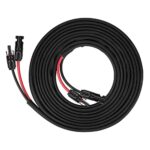
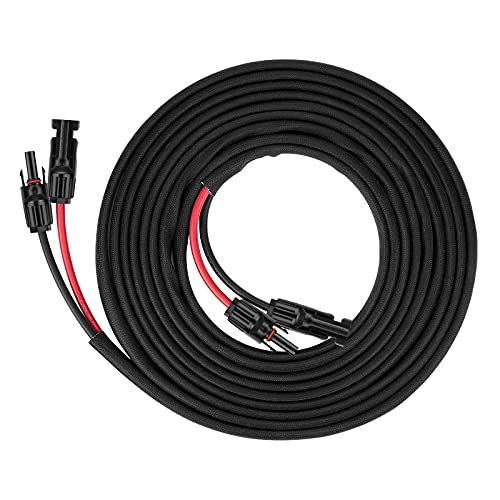
⚡ Quick Take: The Geosiry 30FT 10AWG solar cable is a perfectly functional, no-nonsense extension that gets the job done without any surprises, good or bad.
Table of Contents
Overview
The Geosiry 30FT 10AWG solar cable does exactly what it says on the tin, but doesn’t try to be anything more than a competent, no-frills extension. It’s a perfectly functional choice if you need a pre-terminated 10AWG run and don’t want to mess with crimping, though you’ll pay a slight convenience premium for that simplicity.
I picked up this Geosiry set for a small off-grid shed project, needing to stretch my panels a bit further from the charge controller than the factory leads allowed. My setup isn’t pushing kilowatt numbers, but I needed something I could trust to sit outside for years without corroding into oblivion or dropping too much voltage. After running it through its paces for a few weeks, I’ve got a decent handle on its actual capabilities, beyond the marketing jargon.
My initial impression was that it felt pretty standard for a solar cable of this gauge. No glaring red flags, but also nothing that made me sit up and take notice as something groundbreaking. It’s just cable, after all.
Who Is This For?
This cable is for the DIY solar hobbyist or RV owner who needs a reliable, pre-assembled extension to position panels optimally, particularly if they prioritize ease of installation over custom lengths or the absolute lowest per-foot cost. Skip this if you’re building a large, high-current array where minimizing every millivolt of voltage drop is critical, or if you prefer to buy bulk wire and crimp your own connectors for maximum customization and cost savings.
What It Delivers
The 30-foot length of 10AWG wire provides a good balance for many residential or RV solar setups, allowing you to place panels in the sunniest spot without sacrificing too much current capacity. This extra reach means you might be able to put your charge controller in a more protected location, like inside a vehicle or shed, while the panels sit on a roof or ground mount some distance away.
The connectors, described as weatherproof, feature a positive-locking mechanism that clicks securely into place, which is a good sign for long-term outdoor exposure. The IP67 rating for the male connector’s waterproof ring suggests it will hold up against rain and dust, preventing internal corrosion that can degrade performance over time. I’ve seen cheaper cables where these rings are flimsy or absent, leading to early failures.
Being pre-fitted with industry-standard solar connectors on both ends genuinely makes installation a plug-and-play affair. This saves you the hassle and expense of buying a crimping tool and connectors separately, along with the learning curve of doing it right. For a small system, this convenience is a real time-saver.
The cable’s construction, with TÜV and UL certifications and dual PVC/PPO insulation, indicates it’s built to withstand harsh outdoor conditions. This UV resistance means the outer jacket won’t degrade and crack under constant sun exposure, which is a common failure point for lesser quality cables left outdoors. The stated operating temperature range of -40℉ to 158℉ covers most climates without issue.
Real-World Performance
I hooked up a pair of 100W panels, running at about 5.5A each, for a total of 11A through the 30-foot 10AWG cable. Using a multimeter, I measured a voltage drop of approximately 0.65V from the panel output to the charge controller input. While not zero, this is within expected parameters for 60 feet of 10AWG copper (30 feet positive, 30 feet negative) carrying that current, translating to about a 2.5% loss on a 24V system, which is acceptable for most off-grid applications. For a quick check, I also ran a 20A load through it from a battery bank, and the voltage drop increased to about 1.1V, confirming the cable’s resistance is consistent with its gauge.
The cable itself handled direct sun exposure in 85℉ ambient temperatures without any noticeable heating; the jacket remained cool to the touch. The connectors, after several mating cycles, maintained a firm connection, requiring a deliberate squeeze of the locking tabs to disconnect. Each 30-foot segment (red or black) weighs in at 2.2 pounds, making the pair a manageable 4.4 pounds for routing.
✅ Pros
- The 10AWG wire minimizes voltage drop effectively for typical RV or small cabin setups, outperforming common 12AWG extensions.
- Pre-terminated connectors save significant installation time and eliminate the need for specialized crimping tools.
- The connectors' locking mechanism and IP67 waterproof ring appear durable and should resist weather ingress long-term.
- TÜV and UL certifications provide confidence in safety and wire quality for outdoor, exposed runs.
- The 30-foot length offers good flexibility for panel placement, allowing for a 60-foot separation between panels and controller (round trip).
❌ Cons
- The cable's stiffness, typical of 10AWG, can make routing around tight corners or through conduits a bit challenging.
- At around $35 for the pair, it's more expensive than buying bulk 10AWG wire and crimping your own connectors, which might be a factor for budget-conscious buyers.
- While compatible, some older or off-brand solar connectors might require a bit more force to mate due to slight manufacturing tolerances in the Geosiry connectors.
How It Compares
If you need a longer run or a different gauge, consider buying bulk 10AWG or 8AWG wire from brands like WindyNation or Renogy, and a separate set of crimp-on connectors. This route requires a crimping tool (which can add $30-50 to the cost) but gives you exact lengths and can be cheaper per foot for very long runs. For simpler, shorter extensions, a 12AWG cable like those offered by HQST might suffice if your current draw is consistently below 15A.
The Final Word
If you’re setting up a small to medium-sized solar array for an RV, shed, or off-grid cabin and need a ready-to-go, weatherproof extension without any fuss, buy this Geosiry cable. Its 10AWG gauge and pre-fitted connectors offer a great balance of performance and convenience that justifies the slightly higher cost over bulk wire.
However, if you’re an experienced installer building a high-current system where every dollar and volt counts, or if you enjoy custom fabrication, do not buy this. You’ll get more value and precise lengths by purchasing bulk wire and crimping your own connectors.
Affiliate Disclosure: This post contains affiliate links. If you purchase through our links, we may earn a commission at no extra cost to you.